How It Would Work
Under RAF command throughout, taking operational direction from local resilience forums in emergencies. No new headquarters. Mobilised in under an hour.
Project Sentinel would operate as an auxiliary service under Royal Air Force command at all times. For military roles it would be tasked through the RAF or a designated Joint command; when supporting civil contingencies it would take operational direction from Local Resilience Forums, Strategic Coordinating Groups, and Category 1 and 2 responders, while remaining under RAF command.
It is explicitly dual-use: it provides ground-truth reporting and support to military operations while strengthening the civil response to emergencies. This model mirrors the successful arrangements used by the original Royal Observer Corps, and ensures maximum operational flexibility with minimum additional overhead. The structure that makes it possible is simpler than it sounds, and reuses what already exists.
How it is tasked
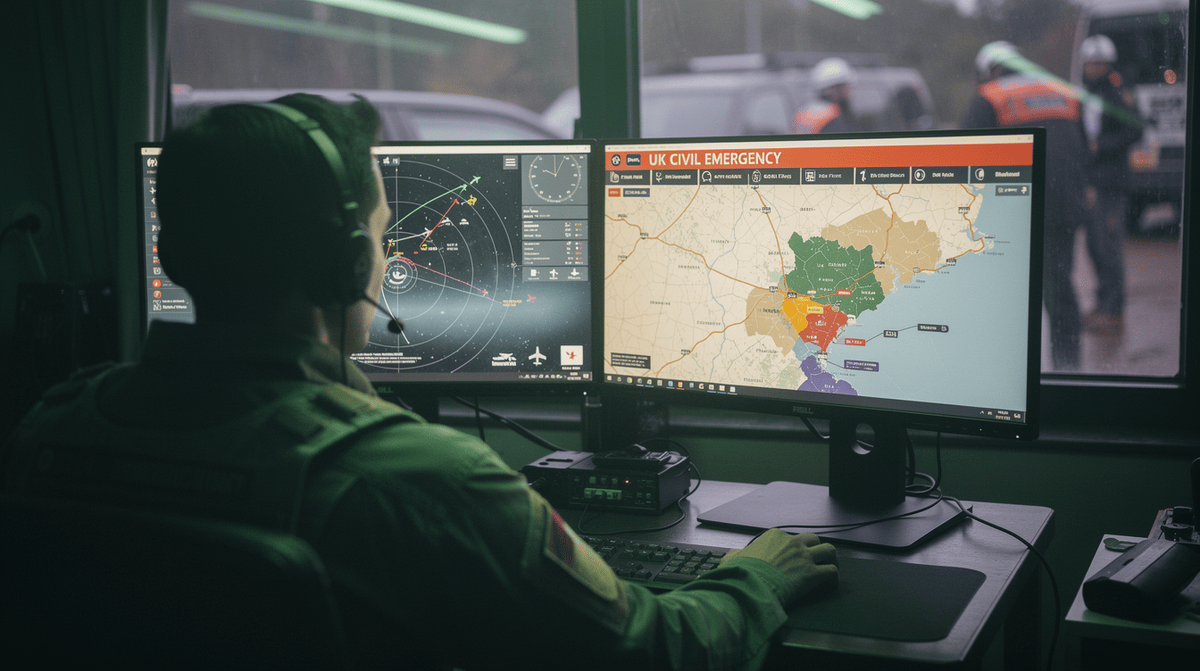
Units operate under clear rules of engagement and tasking protocols. As an auxiliary service they remain under RAF command at all times. In peacetime and during civil emergencies they take operational direction from the relevant Local Resilience Forum and Strategic Coordinating Group; for military tasking they answer to RAF or Joint command. The same volunteers, standards and equipment serve both, maximising value, minimising overhead.
In plain terms, the Corps does not freelance. It is called out, tasked, recorded, supervised and stood down through recognised structures. That discipline is exactly what separates a useful national capability from informal goodwill.
One command, two roles
A single chain of command is the heart of the proposal. The service stays under RAF command throughout; defence tasks come from defence command, and civil-emergency support takes its direction from local resilience structures. The same trained volunteer is useful to both.
- Military tasking: commanded through the RAF, or a designated Joint commander, drawing on existing ROCA networks and volunteer discipline.
- Civil tasking: operational direction from Local Resilience Forums, Strategic Coordinating Groups and Category 1/2 responder structures, exactly as the original ROC worked with local authorities, while command remains with the RAF.
No new bureaucracy
No new headquarters or department is required. Existing Royal Observer Corps Association groups already provide a ready-made regional framework. National coordination can be handled by a small embedded cell within an existing RAF or Cabinet Office function.
Established as an auxiliary service under RAF command, it sits within existing armed-forces protocols and legislation, avoiding the legal and liability complications of standing up a separate civilian body. The framework can build directly on the parts of the ROCA that already work.
Rapid activation
Volunteers can be mobilised in under 60 minutes on an intelligence-led basis. Activation is triggered at the first credible indicators of elevated threat, drawn from GCHQ, Five Eyes and other sources, not after the first strike. Fully mobile assets are held at RAF and Reserve units, ready to move.
This matters because a warning system that waits for damage has already failed. The aim is to move early when risk rises, especially around places where a cheap attack could have expensive consequences.
Using what already exists
The pilot can use existing Air Cadet facilities on non-cadet nights, with strict safeguarding in place. Six regions mirror the established Air Cadet structure. Headquarters at RAF Wyton, with a sub-headquarters option at RAF Honington.
Reusing the estate keeps the first version realistic. Britain does not need to buy new buildings to test the idea, it needs a disciplined pilot, clear safeguarding, proper vetting and a small command cell.
Command and people
An Air Commodore in command; around 30 full-time officers trained at RAF Cranwell, at roughly £5 million a year; volunteers fully vetted and integrated with Defence Intelligence; joint training with the RAF Regiment and counter-drone units. Modest numbers, professional standards, real accountability.
The Ask
A capability Britain can stand up before the next crisis, not after it.
Project Sentinel needs no new department, no new headquarters, no blank cheque. It needs a decision to fund a pilot. Get in touch, share it with anyone who can take it forward, and help move the proposal from paper to a working capability.