Civil Defence and Resilience
This is the role the public will see first: local people helping with floods, welfare, logistics and first aid, supporting the blue-light services, never replacing them.
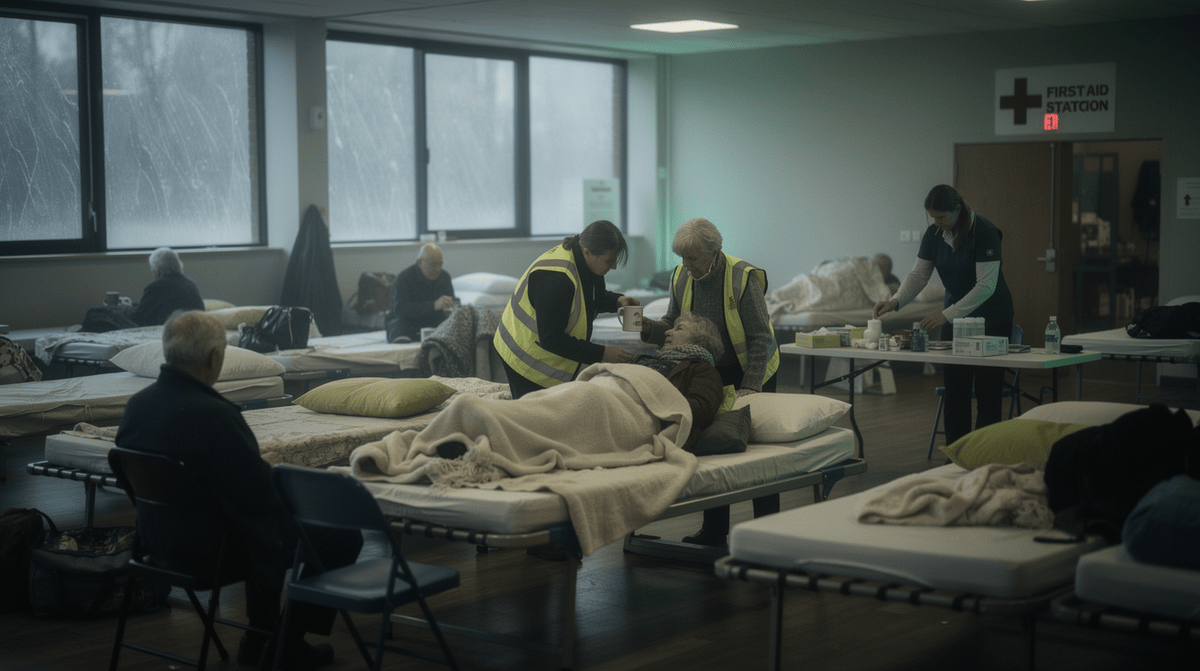
In addition to its military utility, Project Sentinel would provide immediate support to civil authorities during flooding, extreme weather, and other major incidents. Civil defence here means practical help in real places: observation, reporting, welfare, logistics, rest centres, first aid and local knowledge when systems are under pressure.
It restores a proven UKWMO-era capability for today’s emergencies, with volunteers trained to assist in ground-truth reporting when communications and infrastructure are degraded, support to rest centres and logistics, advanced first aid and casualty evacuation, and the detection and localisation of unauthorised drone activity near prisons and critical infrastructure.
Purpose
The aim is to restore a dual-use, UKWMO-era volunteer observation capability that serves modern military and civil-resilience needs at once. Most of the time, the civil role is the one the public will actually see.
It is deliberately unglamorous and deliberately useful: eyes, hands, local knowledge and discipline, supporting existing responders when they are stretched.
Built on a proven foundation
The Royal Observer Corps formed the backbone of the UK Warning and Monitoring Organisation through the Cold War, reporting nuclear bursts and fallout while working hand-in-glove with local authority emergency structures. That volunteer-based, nationally distributed model delivered reliable ground truth when technical systems were degraded or overwhelmed. Project Sentinel re-roles it for the threats of today.
It already works abroad
- Sweden, Hemvärnet (Home Guard): a large standing volunteer force integral to defence and crisis response.
- Denmark, Luftmeldekorpset: a volunteer air-observation corps maintained for exactly this purpose.
- Norway and Finland, comparable dual-use volunteer observation and resilience forces, in continuous service.
What it would do in an emergency
Volunteers support existing responders, they never replace them. The tasks are practical and immediate:
- Support to major incidents, flooding and extreme weather.
- Ground-truth reporting and cueing when communications and infrastructure are degraded.
- Spotting and helping to locate drone activity around prisons and the border.
- Logistic and rest-centre assistance to Category 1 and 2 responders.
- Advanced first aid and casualty evacuation, triage and blast-injury treatment.
Proven, recently
During the COVID pandemic, members of ROCA No 13 (Carmarthen) Group volunteered to build wards at the Nightingale Hospital in Cardiff and decontaminate ambulances at Morriston Hospital in Swansea, 25 years after the Corps stood down. The capability did not vanish in 1995. It is waiting to be organised again.
Command and integration
Project Sentinel runs as an auxiliary service under RAF command at all times, taking operational direction from civil-contingency structures when supporting emergencies. It needs no new bureaucracy, it restores and modernises a proven national capability with immediate value on both sides.
The Ask
A capability Britain can stand up before the next crisis, not after it.
Project Sentinel needs no new department, no new headquarters, no blank cheque. It needs a decision to fund a pilot. Get in touch, share it with anyone who can take it forward, and help move the proposal from paper to a working capability.